Reasonable Adjustment Digital Flag Policy
Reasonable Adjustment Digital Flag Policy
|
Version |
Edited by |
Date issued |
Next review date |
|
2 |
Janet Butcher |
18.02.2026 |
18.02.2027 |
|
Position |
Named individual |
|
Practice Manager |
Janet Butcher |
Overview for all staff
· The Reasonable Adjustment Digital Flag (RADF) is a national record that indicates that reasonable adjustments are required for an individual.
· The RADF optionally includes details of their significant impairments, the key adjustments that should be considered and the underlying conditions.
· Reasonable adjustments must be recorded using established SNOMED CT codes.
· The RADF must be highly visible, obvious and apparent and appear on every page of the electronic healthcare record.
· Consent must be obtained from patients to share the RADF on the NHS Spine.
· When a referral is made, the reasonable adjustment needs of the patient must be shared appropriately.
Table of contents
2.1 Understanding the Reasonable Adjustment Digital Flag
2.3 Identifying using the TEACH model
2.4 Categories and types of adjustments
2.5 Recording reasonable adjustments
2.6 How to create a local digital flag
2.8 How to share identified reasonable adjustment needs
2.9 Reviewing reasonable adjustments
2.11 Making information accessible
2.12 Environmental considerations
1 Introduction
1.1 Assessment and approval
This policy outlines how this Practice will ensure compliance with the Reasonable Adjustment Digital Flag Information Standard (the Standard herein), thereby ensuring all patients inclusively can access the services provided when they need to.
1.2 Status
In accordance with the Equality Act 2010, we have considered how provisions within this policy might impact on different groups and individuals. This document and any procedures contained within it are non-contractual which means they may be modified or withdrawn at any time. They apply to all employees and contractors working for the Practice.
2 Policy
2.1 Understanding the Reasonable Adjustment Digital Flag
NHS England explains that the Reasonable Adjustment Digital Flag (RADF) is a national record that indicates that reasonable adjustments are required for an individual and optionally includes details of their significant impairments, the key adjustments that should be considered and the underlying conditions.
The RADF is built into the NHS Spine, enabling healthcare staff to record, share and view details of any required reasonable adjustments wherever the individual is seen.
2.2 Full conformance
Full conformance with the standard has been extended to 30 September 2026, enabling the Practice to share information digitally to and from the RADF, either via a Fast Healthcare Interoperability Resource (FIHR®) Application Programme Interface (API) or via the National Care Records Service (NCRS).
2.3 Identifying using the TEACH model
The TEACH model at Annex A can be used to help staff at this Practice to identify the reasonable adjustment needs of patients.
2.4 Categories and types of adjustments
NHS Digital provides examples of the categories of adjustments and the types of adjustments.
2.5 Recording reasonable adjustments
Reasonable adjustment requirements must be recorded using established codes. This Practice will use the reasonable adjustments impairment and adjustment codes provided by NHS Digital when recording reasonable adjustments.
Furthermore, Appendix B of the Requirements Specification provides SNOMED CT codes grouped by category.
2.6 How to create a local digital flag
The RADF must be highly visible, obvious and apparent and appear on every page of the electronic healthcare record as an alert, flag or banner. This ensures that staff are prompted and can respond to the individual’s reasonable adjustment requirements.
This Practice will use the SNOMED code “requires reasonable adjustment for health and care access (Equality Act 2010) 1108111000000107” for the identification of identified reasonable adjustments (a local digital flag). Detailed guidance on how to create alerts is available in the clinical record system user guide.
An example of a flag that can be created has been provided by NHS Digital in the form of a case study. The Guide to Using the Reasonable Adjustment Flag in the National Care Records Service (NCRS) provides guidance on how to create, view, update and delete a reasonable adjustments flag.
2.7 Consent to share
NHS England explains that consent must be obtained to share the RADF on the NHS Spine. Staff must ask patients if information can be shared and record consent. Suggested wording for the question is “Are you happy for this to be shared with other Practices in the NHS and social care that will be involved in your care?”
Should a patient lack capacity to make a decision to agree or decline to share, then a capacity assessment may need to be made and/or a best interests decision made.
Consent must be recorded using the consent code “consent given to upload data to Reasonable Adjustment Digital Flag (finding) 1853771000000105”.
2.8 How to share identified reasonable adjustment needs
This Practice must ensure that a patient’s reasonable adjustment needs are shared appropriately, such as when the patient is referred or signposted to other Practices. When a referral is made, staff are to ensure that under the identifying demographic section, reasonable adjustments are annotated. The Implementation Guidance offers the following example:
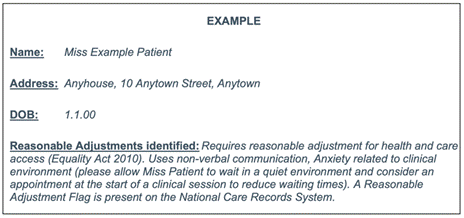
Staff at this Practice will ensure information is extant and reflects the needs of the individual.
2.9 Reviewing reasonable adjustments
It is likely the needs of patients will change over time; therefore, any recorded reasonable adjustments are to be reviewed and updated (when appliable) to ensure the needs of the patient continue to be met. This Practice will use the following opportunities to review reasonable adjustments:
|
Standardised review |
· Annual healthcare check · Long term condition annual reviews |
|
Proactive review |
· Searches to identify those not reviewed in the defined review period · Invitation to review on any invitations for screening or other routine, planned care · Flu clinics |
|
Reactive review |
· Opportunistic review on diagnosis of a new condition or impairment · Patient/carer self-presentation |
Staff at this Practice will maximise the opportunities to review patients and update their RADF accordingly.
2.10 Audit
To monitor compliance with this policy, audits will be undertaken to ensure the needs of patients are met and continuously reviewed and updated as detailed above at Section 2.9. Audits are to take into consideration the conformance criteria detailed in the Reasonable Adjustment Digital Flag – Requirements Specification.
2.11 Making information accessible
Staff will ensure that they adhere to the Practice’s Accessible Information Standard Policy and provide information to patients that meets their language and communication needs. This includes providing individuals with alternative ways of communicating with the Practice such as via email, text or telephone and the provision of information in alternative formats, i.e., braille, easy read, large print etc.
This policy should be read in conjunction with CQC’s Meeting the Accessible Information Standard.
This Practice has an Accessibility Statement that applies to the Practice’s website.
2.12 Environmental considerations
Staff must be mindful of the need to meet any preferred environmental requirements of patients with a RADF. To ensure such needs are met, it is imperative that the flag contains all the relevant information, for example, “Requires distraction technique whilst undergoing care procedure” or “Requires approach to care to be discussed with carer”.
A detailed example can be found at Appendix A of the Implementation Guidance.
Furthermore, to better involve patients in their own care, staff must adhere to the guidance detailed in the Practice’s Shared Decision-Making Policy.
2.13 Training
All staff are required to complete The Oliver McGowan Mandatory Training on Learning Disability and Autism – Tier 1 e-learning. Tier 2 training, which is delivered face-to-face, must also be completed by all staff when it becomes available.
2.14 Additional resources
A good practice resource package is accessible via FutureNHS (login required) and this Practice will use resources appropriately to promote the RADF to patients.
The following information was sourced from Hertfordshire County Council’s Handbook and information on the Purple Pledge of Principles Recognition.
|
Time |
Does the person find it hard attending health appointments at a certain time of day? Does the person need extra time for them to feel relaxed so that they can accept treatment? Does the person need extra time to explain things? |
|
Environment |
Would the person be more likely to be relaxed and accept health treatment if they are in a place they know well? Does the person dislike noises, busy spaces or new places? What can be done to make it easier? |
|
Attitude |
If the person is anxious, what can be done to help them to relax so that they are more likely to get the same treatment as someone else? |
|
Communication |
How should people talk to the person? Are there things that they hate people saying or doing? Does the person have a favourite subject that they like to chat about that helps them to feel relaxed? Are there things the person likes to show people to help them to settle? Does the person need things written down or drawn to help them to understand better? |
|
Help |
Does the person have any reasonable adjustments recorded, showing what they need and what they usually communicate and behave like, so that staff can recognise signs of change? |
Staff at this Practice should take the above into consideration when determining what reasonable adjustments are required to meet the needs of the patient.
Page created: 23 March 2026